When a boiler breaks down, particularly more than once, it is reasonable to ask whether a further repair is worthwhile or whether the money would be better spent on a replacement. There is no single answer for every home, but the following points will usually make the right choice clear.
The quick answer
Repair it if the boiler is under about 10 years old, has been reliable, the fault is a one-off, and the parts are easy to get.
Think about replacing it if it's 10 to 15 years old or more, keeps breaking down, needs a big part, the parts are no longer made, or an engineer has told you it's unsafe.
Six factors to consider
1. How old is the boiler?
A gas boiler that's been fitted properly and serviced every year usually lasts around 10 to 15 years. Age on its own isn't a reason to replace a boiler that works well, but an older boiler is more likely to need another repair soon after this one. You'll usually find the model and often the year on a label inside the front flap or on the paperwork from when it was fitted.
2. How often has it broken down?
One breakdown in several years is normal wear. Two or three callouts in a year suggests a pattern. Each repair may be reasonable on its own, but together they can approach the cost of a new boiler, while leaving you with an ageing appliance.
3. What does the repair cost compared with a new boiler?
A useful rule of thumb: if a repair would cost around half the price of a new boiler or more, and the boiler is getting on, replacing it is usually the better use of your money. Small repairs like a sensor or a valve on a younger boiler are almost always worth doing. Ask your engineer for the cost of both so you can compare.
4. Can the parts still be found?
Manufacturers stop making parts for older models. When that happens, repairs take longer because parts have to be tracked down, they cost more, and sometimes they can't be found at all. If an engineer struggles to source a part for your boiler, that's a strong sign it's near the end.
5. Is it safe?
Safety always comes first. If a Gas Safe engineer classes your boiler as "At Risk" or "Immediately Dangerous", it must not be used until the problem is put right. Sometimes the fix is simple. Sometimes, on an old boiler, the repair isn't worth it or isn't possible, and replacing it is the only safe option.
6. Is it still under warranty?
Check this before arranging any paid repair. Many newer boilers come with a manufacturer warranty, often for several years, and a covered fault may be repaired at no cost to you. Most warranties only stay valid if the boiler has been serviced every year, so keep your service records.
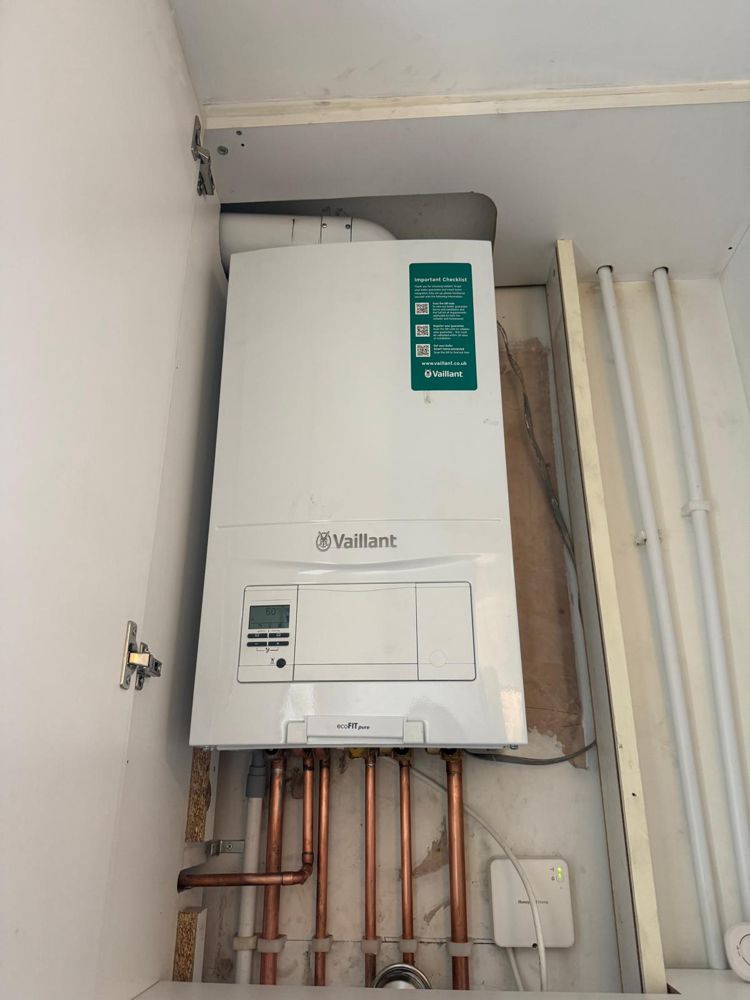
Signs your boiler may be near the end
- Breakdowns are becoming regular
- Parts are hard to find or no longer made
- Leaks, rust or corrosion on or under the boiler
- Banging, gurgling or kettling noises
- Hot water and heating are slower than they used to be
- Gas bills rising without any change in use
- It's an old non-condensing or back boiler
Since 2005, new gas boilers fitted in England have generally had to be condensing boilers, which make use of heat that older boilers send out of the flue. If yours was fitted before then and has a metal flue and no plastic condensate pipe running to a drain, it may be a non-condensing model, and a modern boiler with good controls is likely to cost less to run.
When repairing makes more sense
- The boiler is under about 10 years old
- It's been reliable until now
- The fault is minor and the parts are available
- It's still under the manufacturer's warranty
- It's been serviced every year
We will never recommend a new boiler that you do not need. If your boiler can be repaired and it makes sense to repair it, thinking about the cost and how reliable it's likely to be in future, we'll fix it.
Get an honest opinion
If you are unsure which option is right, we'll inspect your boiler, tell you what's wrong, and tell you how much the repair will cost before any work is done or any parts are replaced. If replacing it would make more sense, we'll explain why and tell you what a new boiler would cost too, so you can compare. We cover Streatham, Croydon and South London. See our boiler repair and new boiler installation pages, call 020 8036 1120, or use the form to request a callback. Whichever you choose, an annual service is the best way to make your boiler last.
Common questions
A gas boiler that is fitted properly and serviced every year usually lasts around 10 to 15 years. Some go on longer, but past that age breakdowns tend to become more frequent and parts get harder to find.
Sometimes. If it has been reliable, the fault is minor and the parts are still available, a repair can be the sensible choice. If it has broken down several times recently, needs an expensive part, or the parts are no longer made, the money is usually better put towards a new boiler.
It depends on the type and model of boiler, whether it stays in the same place, and how much work the rest of the system needs. A like-for-like swap costs less than moving the boiler or changing to a different type. We visit, look at your home, and tell you exactly what it will cost before any work starts.
If a Gas Safe engineer finds your boiler is unsafe, they follow an industry procedure. An appliance classed as "At Risk" will be turned off with your permission and should not be used until it is fixed. One classed as "Immediately Dangerous" will be disconnected with your permission and labelled, and must not be used until it is repaired or replaced. This is for your safety.
If you are replacing an old non-condensing boiler, a modern condensing boiler with good controls is likely to use less gas to heat your home. How much you save depends on your old boiler, your home and how you use your heating, so be wary of anyone who promises an exact figure.
This guide is general advice for homeowners. Every boiler and home is different, so for advice on your own boiler, speak to a Gas Safe registered engineer.