Your boiler's pressure gauge has dropped, the heating has stopped, or you're having to top it up more often than you'd like. Here's what's normal, the usual causes, what you can safely check yourself, and when it's time to call an engineer.
What pressure should your boiler be?
Most combi and system boilers in UK homes should sit at about 1 to 1.5 bar when the heating is off and the system is cold. When the heating runs, the water expands and the pressure rises a little, often to around 2 bar. That's normal.
- Below about 1 bar: low, and many boilers lock out
- 1 to 1.5 bar when cold: normal
- Up to about 2 bar when hot: normal
- Above about 2.5 to 3 bar: too high, check below
You'll find the pressure on a dial on the front or underneath the boiler, or on the digital display on newer models. Your boiler's manual gives the exact figures for your model.
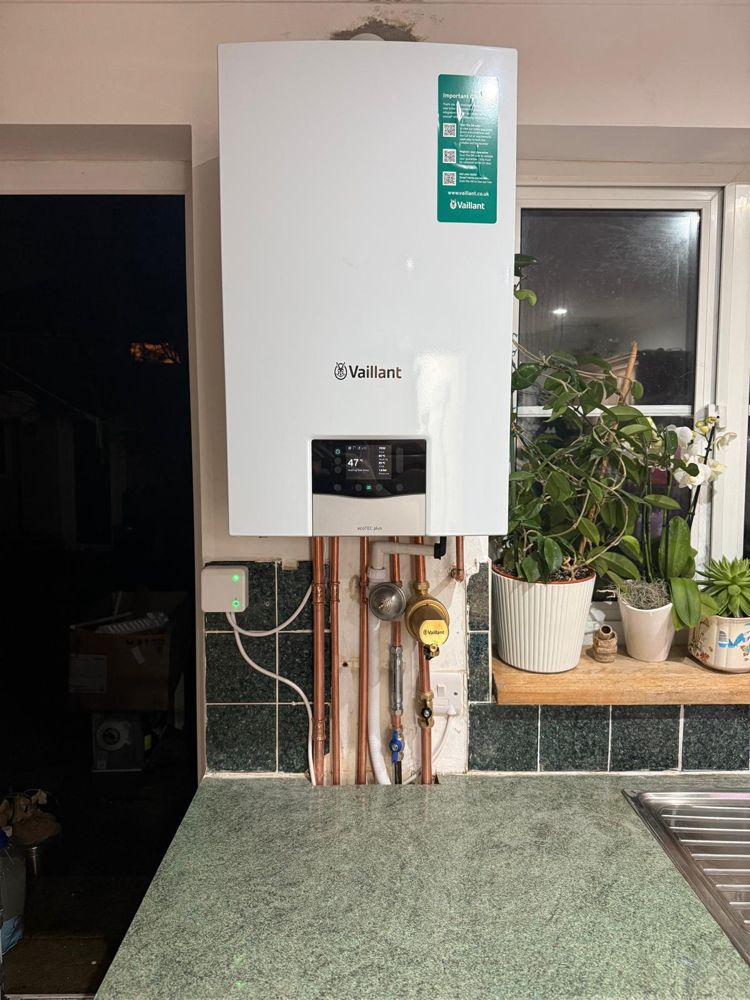
Why boilers lose pressure
Your heating is a sealed system, so if the pressure keeps falling, water is getting out somewhere or a part that controls the pressure has stopped working. The usual suspects are:
1. A small leak in the pipes or radiators
The most common cause. Look for drips, damp patches or green or white crusting around radiator valves, pipe joints and under the boiler. Even a slow drip you'd never notice can drain the pressure over a few days.
2. You've recently bled the radiators
Bleeding radiators lets air out, and the pressure drops with it. That's expected. You just need to top the boiler back up afterwards.
3. The pressure relief valve is letting water out
This safety valve releases water if the pressure gets too high. If it's worn or faulty, it can let water out when it shouldn't. A small copper or plastic pipe usually runs from the boiler to an outside wall. If that pipe is dripping or there's a damp patch under it, the valve is opening.
4. The expansion vessel has lost its charge
Inside the boiler, the expansion vessel takes up the extra volume when hot water expands. If it loses its air charge, the pressure shoots up when the heating is on, the relief valve lets water out, and then the pressure drops too low when it cools. If your pressure swings a lot between hot and cold, this is a likely cause. It's a job for an engineer.
5. A leak inside the boiler
Seals, joints, the pump or the heat exchanger can start to leak inside the casing. You might see water dripping from the bottom of the boiler. Turn the boiler off and call a Gas Safe engineer. Don't take the cover off.
What you can safely do yourself
These checks are safe for most homeowners and don't involve opening the boiler:
- Check the gauge with the heating off and cold. That gives you a true reading.
- Top up the pressure using the filling loop. This is usually a silver braided hose or a built-in key or lever under the boiler. Follow your boiler manual. Open the valves slowly, watch the gauge rise to around 1 to 1.5 bar, then close them fully. Leaving them open can push the pressure too high.
- Reset the boiler if it locked out, using the reset button or as the manual describes.
- Look for leaks around radiators, valves, visible pipes and under the boiler.
- Check the pipe outside. Find the small pipe from the boiler that comes out through an outside wall and see if it's dripping.
- Keep an eye on it for a few days. If it stays steady, it was probably just air or a one-off. If it drops again, it needs looking at.
When to call an engineer
- You're topping up more than once or twice a year
- The pressure drops within days of topping up
- Water is dripping from the boiler itself
- The outside relief pipe is dripping
- The pressure goes above about 2.5 to 3 bar
- The boiler keeps locking out or shows an error code
Catching a pressure problem early usually means a simpler, cheaper repair. Left alone, a slow leak can damage floors and ceilings, and constant topping up brings in fresh water that speeds up corrosion inside the system.
Need it looked at?
We fix boiler pressure problems across Streatham, Croydon and South London. You'll get an honest diagnosis and a fixed price before any work starts. See our boiler repair page, call 020 8036 1120, or use the form to request a callback. If your boiler is old and keeps going wrong, it may be time to look at a new boiler, and an annual service helps catch problems like a flat expansion vessel before they leave you without heating.
Common questions
Most combi and system boilers should read between 1 and 1.5 bar when the heating is off and the system is cold. It is normal for it to rise a little, to around 2 bar, when the heating is running. Always check the manual for your model, because some manufacturers recommend slightly different figures.
Low pressure on its own is not usually dangerous. Most boilers simply lock out and stop working to protect themselves. But if the pressure keeps dropping, there is a leak or a fault somewhere, and water leaking inside the boiler casing needs a Gas Safe engineer.
Very rarely. Topping up once or twice a year, or after bleeding radiators, is normal. If you are topping up every week or two, something is wrong and it is worth getting it checked before it leads to a breakdown.
You can safely top up the pressure, bleed radiators and look for visible leaks on pipes and radiator valves. Anything inside the boiler, including the expansion vessel, pressure relief valve and heat exchanger, must be checked by a Gas Safe registered engineer. Never remove the boiler casing yourself.
If the gauge reads above about 2.5 to 3 bar, the filling loop may have been left open or the expansion vessel may have lost its charge. Make sure the filling loop valves are fully closed. If the pressure stays high, or water is coming out of the small pipe that runs outside from the boiler, call an engineer.
This guide is general advice for homeowners. Every boiler is different, so always follow your manufacturer's instructions, and if you're unsure, call a Gas Safe registered engineer.